Institutional anti-Muslim Racism in Action

From May 2024 until July 2025, I worked at the University of Prince Edward Island as the inaugural Director of the (new) Department of Equity, Diversity, Inclusion (EDI) and Human Rights. As a Muslim and racialized leader working in equity, diversity, and inclusion, I believed that meaningful change required speaking truth to power and centering marginalized communities. I was aware of all the critiques of EDI, especially in higher education, so I wanted to do things differently — centering justice and liberation in my work, as I always have tried to do. Unfortunately, as with many universities, this approach does not fit the colonial model to which universities in the West are beholden. I believe that, eventually, my dedication to true justice and liberation became my downfall in that space.
In May 2025, I faced a situation that highlighted the barriers Muslim professionals can encounter within institutions, even when our work is rooted in justice and liberation. The Faculty Association (FA) at UPEI filed an informal complaint about some of my social media posts. They claimed that my posts reflected bias — specifically alleging anti-Semitism and anti-Hindu sentiment. (Being accused of anti-Semitism as a Muslim is, unfortunately, so common that it has become a trope.) According to the HR summary report I received, the FA had requested that I be removed from the Joint Equity Committee (a committee focused on faculty equity issues) and that I no longer be involved in certain areas of work connected to their members.
On June 4, I was called into a meeting with senior administrators to discuss the complaint. I brought two support people with me, but the meeting did not feel trauma-informed or supportive. (I will get to what trauma-informed would have looked like in that space below.) During the meeting, I explained that my work is rooted in social justice and in values of liberation for all — principles that are essential to the work of equity and human rights. I said I am anti-genocide and pro-Palestinian, unapologetically.
I was told that a third-party legal review of my posts would be conducted. The review was carried out by legal counsel in Ontario and I was later informed that that my posts were found to be “incompatible” with my role as Director of the Department of EDI and Human Rights.
While I cannot disclose the details of the complaint itself, I can share examples of the kinds of posts I had been sharing publicly at the time — and continue to share. These are not my own original videos, but public posts from scholars and activists that I reposted because they reflect my values of anti-Zionism and anti-casteism.
Here are some examples of Instagram content I tend to share:
The posts in question were anti-Zionist and anti-casteist, reflecting perspectives critical of occupation, white supremacy, casteism, and systemic oppression. The content was rooted in a commitment to human rights and liberation for all. To me, this is exactly what equity, diversity, and inclusion work requires.
As the brilliant Palestinian-American scholar, Dr. Noura Erakat, states:
Being an anti-Zionist is hardly a radical position. It is basic human decency and commitment to humanity based on the conception of dignity, bodily integrity, and equality of all people.
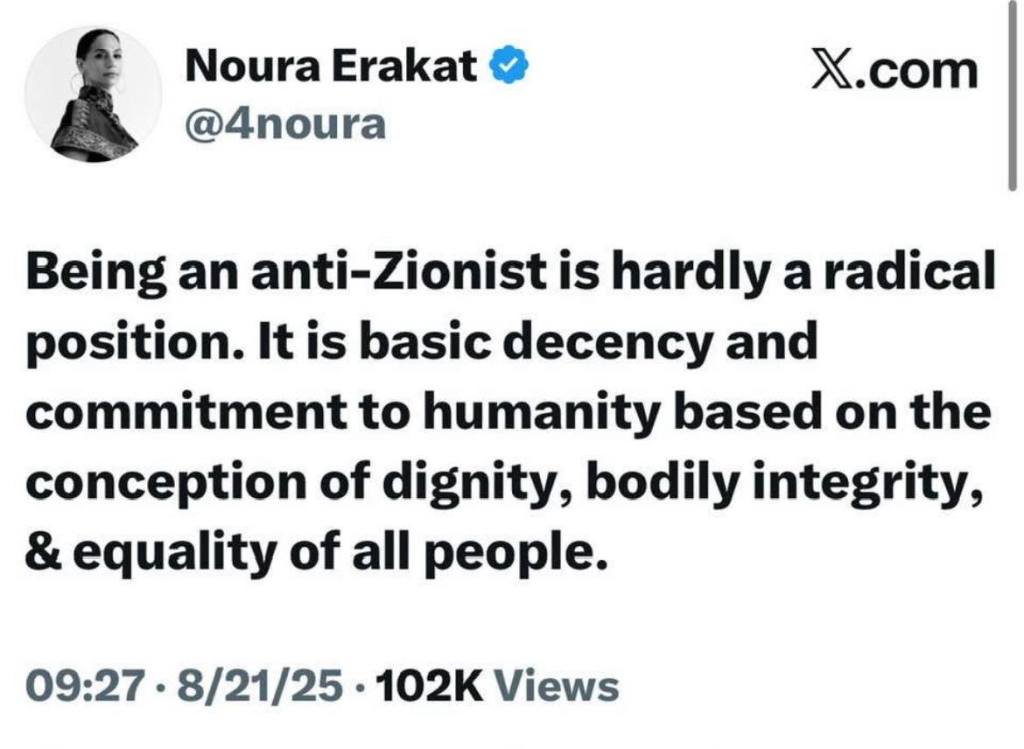
However, for the independent legal counsel and the institution, content like this — content humanizing Palestinians, Muslims, and caste-oppressed people — was deemed “incompatible” with EDI and human rights.
Anti-Muslim Racism
One of the biggest failures of EDI spaces, in my view, is their near-total ignorance and exclusion of anti-Muslim racism. This is often called Islamophobia, but I prefer the term anti-Muslim racism because the hatred Muslims experience is not rooted in our faith, but in the way we are racialized as an inferior “other.”
Most EDI practitioners are not Muslim — but that should not matter. No single practitioner carries the lived experience of all oppressed peoples or identities. Those who work in this field have a responsibility to study, read, and learn about the histories and realities of communities different from their own. Yet, when it comes to the hatred Muslims face, there is often little curiosity, and even less accountability.
Anti-Muslim racism is not new; it is a deeply entrenched form of racial hatred that has existed in the Western world for over a thousand years. What I have observed, however, is that EDI practitioners not only fail to understand it — they often reproduce it. In many cases, anti-Muslim racism and the dehumanization of Muslims are positioned as the “correct” or even “progressive” stance to take. This is profoundly dangerous.
For more on the long and violent history of anti-Muslim racism, I recommend Nothing Has to Make Sense: Upholding White Supremacy Through Anti-Muslim Racism by Dr. Sherene Razack. For a concise introduction to both the book and the concept, watch this interview with the author. It offers an essential context for what I discuss below.
Anti-Muslim Racism and Zionism
It is essential, in any discussion of anti-Muslim racism, to recognize the significant role that Zionism has played in perpetuating anti-Muslim hatred.
Zionism — the political project supporting the establishment and maintenance of the State of Israel as a Jewish ethno-state — depends on the demonization of Palestinians. Zionism is an ideology which anyone can identify with, regardless of religion. In fact, most Zionists today are Christians. (See this video for a necessary critique of the idea of an ethno-state.)
As with other colonial projects, including those on Turtle Island, colonizers have historically relied on the dehumanization of Indigenous peoples to justify and gain support for the theft of land and the violence of displacement and genocide. Zionism operates through a similar logic: Palestinians are framed as threats, terrorists, or inherently violent in order to rationalize the occupation of their lands and the erasure of their existence.
Because most Palestinians and many of their regional allies are Muslim, this dehumanization also fuels and expands anti-Muslim racism — again, a form of hatred that has existed in Europe and the West for over a millennium. Zionists have used known anti-Muslim tropes to garner support for their project in a variety of ways. In this way, Zionism has not only reinforced anti-Palestinian racism but also provided a modern political framework for intensifying anti-Muslim racism globally.
For more on this analysis, I recommend watching this interview with Professor David Miller.
And for more on how Zionism fuels Islamophobia in the US, I recommend reading the report, Fear, Inc.
So, how is this relevant?
Because Zionism fuels anti-Muslim racism, for Muslims, speaking out against it isn’t just a political stance — it’s an act of self-preservation. It is about survival. To claim that my anti-Zionist posts are “incompatible” with equity, diversity, and inclusion work is to declare, in no uncertain terms, that there is no space in EDI for Muslims to name the ideology that endangers us — the ideology that normalizes hatred of Muslims, erases Palestinians, and justifies the ongoing genocide of Muslim peoples, all of whom I consider as part of my ummah.
Given this reality, the June 4th meeting (referenced above) could have been a moment of care and understanding. A trauma-informed approach would have recognized that my posts came from a place of pain, solidarity, and deep personal conviction — that they were about resisting the oppression I, and my communities, continue to face. Instead, the meeting began with me being asked to just “speak” without any context or clarity about what I was being asked to speak to. It was a command, not an invitation — a reminder of power, not care. To then be treated as though I was being reprimanded for calling out my own oppression was devastating. It sent a clear message that my pain was not to be named, that my humanity was conditional. A trauma-informed process would have begun with compassion and curiosity, not ambiguity and punishment.
My experience at UPEI reflects a broader pattern of institutional anti-Muslim racism. Muslim leaders’ values and political expressions are often scrutinized in ways that others’ are not. Solidarity with marginalized communities — especially Palestinians — or critiques of the systemic injustices faced by Palestinians and Muslims, are too easily framed as bias, even when they emerge from a deep commitment to equity and human rights. Institutions often demand a “neutrality” that erases the lived realities of Muslims and limits our ability to lead authentically.
The impact of this is profound. When Muslim professionals are treated as inherently biased — or inherently anti-Semitic — it does not protect equity work; it undermines it. It discourages authenticity, drives Muslim voices out of leadership, and reinforces the very inequities that institutions claim to confront.
I share my story not to assign blame, but to name what must be named. Silence protects systems, not people. By speaking out, I hope to help build braver institutions — places where Muslim voices, values, and leadership can exist without fear of being mischaracterized or silenced.
 sobiaalifaisal.blog
Leave a comment