I just finished reading India: 5,000 Years of History on the Subcontinent by Audrey Truschke. The blurb on the page describes it as follows:
Much of world history is Indian history. Home today to one in four people, the subcontinent has long been densely populated and deeply connected to Asia, Africa, Europe, and the Americas through migration and trade. In this magisterial history, Audrey Truschke tells the fascinating story of the region historically known as India—which includes today’s India, Pakistan, Bangladesh, and parts of Afghanistan—and the people who have lived there.
A sweeping account of five millennia, from the dawn of the Indus Valley Civilization to the twenty-first century, this engaging and richly textured narrative chronicles the most important political, social, religious, intellectual, and cultural events. And throughout, it describes how the region has been continuously reshaped by its astonishing diversity, religious and political innovations, and social stratification.
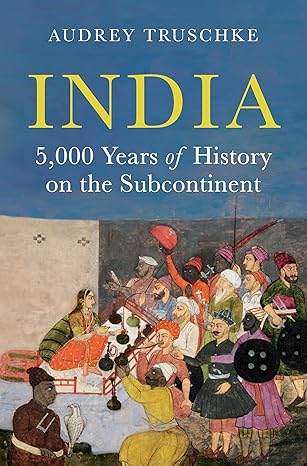
Here, readers will learn about Hinduism, Buddhism, Jainism, Islam, and Sikhism; the Vedas and Mahabharata; Ashoka and the Mauryan Empire; the Silk Road; the Cholas; Indo-Persian rule; the Mughal Empire; European colonialism; national independence movements; the 1947 Partition of India; the recent rise of Hindu nationalism; the challenges of climate change; and much more. Emphasizing the diversity of human experiences on the subcontinent, the book presents a wide range of voices, including those of women, religious minorities, lower classes, and other marginalized groups.
The history of the part of world from which I come is incredibly rich and consequential for the entire world. As anyone would guess, a book that spans 5000 years of history has a great deal of content in it, and the author, while acknowledging this fact, also acknowledges that so much had to be left out of the book as well. I clearly cannot speak too the the contents of the book, but I can say I learned a great deal about this part of the world, which really helped me better understand the realities of today.
In this post, I want to focus on a few of my initial observations from the book.
First, Truschke points out that much of what South Asians understand as “our” history is actually the history recorded by the British. In other words, even today we often view South Asia through a colonial lens, one that perpetuates a distorted version of the past shaped by British colonial (read: racist) assumptions. This isn’t surprising, nor is it unique; colonized peoples across the world have internalized versions of their own histories as told by colonizers.
Dr. Rudolph “Butch” Ware notes a similar pattern across parts of Africa, where many people have understood the spread of Islam through the writings of British colonizers rather than through the accounts of African Muslims themselves. This has produced a false narrative in which Muslims are portrayed as violent enforcers of their religion. In reality, as Dr. Ware demonstrates, Islam spread throughout Africa through the scholarship of African Muslims and trade with Arab Muslim merchants, not through violence.
When I read Truschke’s explanation, it immediately made sense to me. For a long time, I’ve felt that much of what I “knew” about South Asia didn’t feel accurate. There seemed to be very little connection to what a pre-colonial culture might have looked or felt like. So much of what I learned felt filtered through a whitewashed colonial frame, and many of the popular narratives about South Asia always seemed incomplete. They rarely challenged Western assumptions; instead, they reproduced them. Reading this part of Truschke’s book helped clarify why.
This becomes especially clear in conversations about religious tensions in South Asia. Many people claim that conflict between Hindus and Muslims is ancient. Truschke shows that this simply isn’t true. Consequential religious tensions didn’t erupt until the arrival of European colonizers. The Portuguese were the first to introduce a sense of Christian supremacy, and they enforced it brutally, but because most people on the subcontinent had limited interaction with them, this sense of religious hierarchy didn’t take deep root. It wasn’t until the British arrived that religious identity became a primary dividing line. Before that, religion was just one of many identifiers, and not the most important one; class, caste, gender, and local political alliances mattered far more. Religion existed, of course, but it was not an identity loaded with the kind of political weight it carries today.
Truschke’s book offers a view of South Asian history that is not filtered through a colonial lens. She relies on original, often South Asian, sources, and in doing so provides a clearer, more grounded picture of the region’s past.
The second major insight that struck me was just how complex South Asian history truly is. The narrative many of us receive is that South Asia was ruled by distinct religious groups, and that this is the most meaningful way to understand our past. Again, this framing comes directly from colonial thinking. The British categorized colonized people into rigid groups because this made us easier to manage and manipulate. Nuance, complexity, and fluid identities made control harder, so they flattened us into neat compartments – religious, racial, cultural – and taught us to see ourselves that way. Over time, we internalized these categories.
But the actual history of South Asia reflects the complexity of its peoples. Yes, there were Hindu rulers, Muslim rulers, Sikh rulers, Buddhist rulers, and others, but historically they were understood not as “religious regimes” but as kingdoms, dynasties, and empires. No single ruler or empire ever controlled all of what we now call South Asia. Different political entities governed different regions at different times, with borders that constantly shifted. The subcontinent has always been a dynamic, evolving region, not a series of cleanly divided “religious eras,” which is a purely colonial invention.
This leads to my third and final observation: how easy it is to rewrite history for political ends. Today, history is being rewritten once again, most notably by the Hindu nationalist movement in India, whose influence now reaches far beyond India’s borders. Hindu nationalists have fabricated myths about Muslims and Muslim rule in order to justify their deeply anti-Muslim rhetoric. I first heard about Truschke’s book in an interview where she mentioned receiving threats, including death threats, from Hindu nationalists. That was what convinced me I needed to read her work. She refuses to entertain the myths and fabrications they promote.
The actual history of South Asia offers no support for the narrative of “evil Muslims” invading and destroying Hindu culture. Hinduism itself, as Truschke shows, is a complex, evolving tradition shaped by countless influences, including Muslim thinkers, rulers, and communities in different regions. It is a rich, intertwined, and dynamic story. Colonizers flattened it; now Hindu nationalists are flattening it again to serve their political agenda. And that is incredibly tragic.
Obviously in a book covering such a vast amount of history there were many more takeaways, and I could go on for much longer speaking on them all. But for that it is best one reads the entire book, which I highly recommend.
 sobiaalifaisal.blog
Leave a comment