
Last week, Charlottetown MP Sean Casey voted in favour of an NDP motion to stop arms sales to Israel. In response, the Liberal Party demoted him. He lost his role as parliamentary secretary to the minister of veterans affairs. But he kept his seat in Parliament. He kept his $217,700 salary. He lost a $20,900 stipend and a title.
The reaction from PEI’s progressive circles was immediate. White people across the Island praised him. They called him brave. They shared his statement. They said it was rare to see a politician keep his word.
I want to be clear: Sean Casey did the right thing. He voted against arms sales to a government committing genocide. He kept his word to his constituents. I appreciate that.
But let’s be honest about what it cost him. He lost a title. He still has his job, his income, his platform, his safety. He lost a perk. And in return, he gained praise, visibility, and the admiration of the same people who have been silent while Muslims across this country lose their livelihoods for saying the same thing he voted for.
That is not sacrifice. That is a slap on the wrist for voting the right way.
The Real Cost of Speaking Out
While Sean Casey was being praised for losing a title, Muslims across Canada were losing their jobs.
The Muslim Legal Support Centre documented 345 cases of individuals who lost jobs or were placed on leave due to support for Palestine between October 2023 and March 2024. The MLSC received 330 requests for aid in eight months, compared to 22 in the same period the previous year. It handled 123 cases of unjust dismissal without proper cause or notice, plus 45 employees placed on leave.
The National Council of Canadian Muslims reported instances of people losing jobs for “literally just quoting scripture or speaking in Arabic.” The report Documenting the “Palestine Exception” found Islamophobic and anti-Palestinian hate crimes spiked by as much as 1,800% in some regions after October 7th. Lawyers have publicly advocated that students advocating for Palestine shouldn’t be employed. Forced attestation letters have been used to make students distance themselves from Palestine solidarity movements.
These are not abstract statistics. These are people. They have names, families, mortgages, fears about their children’s futures.
Sean Casey lost a title. They lost their livelihoods. And the same people praising him never said a word about them.
UPEI: The Silence and the Applause
I know this not as an observer but as someone who lived it.
In May 2024, I was appointed as the inaugural Director of UPEI’s new Department of EDI and Human Rights. The university’s own announcement described me as bringing “extensive experience, education, and expertise” and said I would “play a critical leadership role” in building a culture of trust and safety. In July 2025, I was fired from that role.
On September 24, 2026, the UPEI Faculty Association appeared before the Standing Committee on Education and Economic Growth of the PEI Legislature to discuss the Rubin Thomlinson report on harassment and discrimination at UPEI. The union’s executive director, Margot Rejskind, told the committee that “really nothing has changed” on the harassment and discrimination policies, and that UPEI “was able to blow by” the hard deadline in the action plan. The Faculty Association was critical of the administration on almost everything — slow progress, lack of transparency, unmet deadlines.
But the one thing they praised was the restructuring of the Department of EDI and Human Rights. The restructuring that removed me.
They said the university had responded to a workplace assessment by restructuring the department. That, they said, was a good thing.
A union praising an employer for a firing is unusual. A union praising an employer for a firing that skipped every fair labour practice is something else entirely.
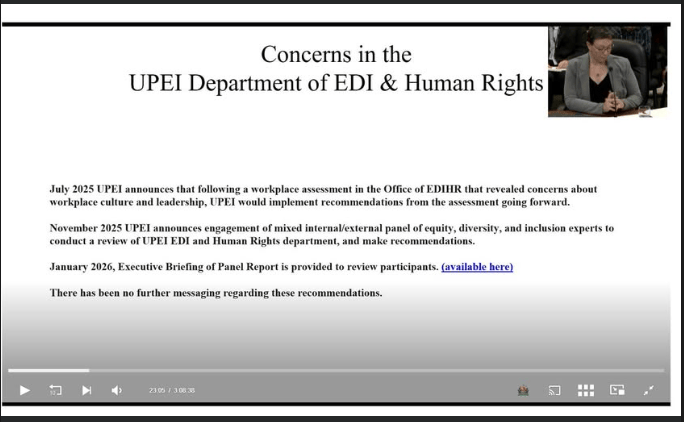
UPEIFA presentation to the Standing Committee on Education and Economic Growth — slide on the restructuring of the Department of EDI and Human Rights. Full recording available at https://www.assembly.pe.ca/committee-archive on the PEI Legislative Assembly website, for September 24th, 2026.]
A union that had spent years criticizing the UPEI administration on almost every file found common ground with that administration on exactly one point: the removal of a racialized Muslim woman from the position she was hired to fill.
And here is what makes that praise even more hollow. The Faculty Association has never seen that workplace assessment. They don’t know what was in it. And they don’t know, because they have no way of knowing, that the assessment was conducted by someone without the lens to understand what was actually happening in that department. She was not an EDI practitioner. She was not an equity practitioner. She did not have the framework to read the racial dynamics, the identity-based conflict and weaponization of identity politics, the bullying, the harassment, the ableism that were playing out in that department every day. I saw all of it. She had no clue because she did not know what to look for or ask about.
I’ll write about those dynamics in a separate post. But for now, the point is this: the Faculty Association praised a process it did not understand, based on a document it never read, to justify an outcome it wanted.
One Strike and You’re Out
Let me be clear about why I was fired. The university will say it was the workplace assessment. I don’t believe that. I was fired because I was openly, unapologetically pro-Palestinian, and that made me a liability. (I’ve written about this here and here.) The assessment was the excuse they needed.
But even if you take their account at face value, even if you accept the assessment was legitimate and identified real problems, the process was indefensible. I was fired without warning. There was no progressive discipline. No performance plan. No conversation about expectations. No opportunity to respond to whatever was alleged. The first issue that came up, I was gone.
One strike and you’re out.
That is not a defensible HR process. Progressive discipline is a basic principle of labour practice. It exists precisely so that institutions don’t remove people over a single complaint, a single contested assessment, a single bad week. Skipping it isn’t a shortcut. It is a signal: the outcome was decided before the process began. The process was never about addressing a problem. It was about removing a person.
And this is a familiar pattern for racialized women. The first time there’s an issue, or the first time you become one, you are not managed, supported, or given the chance to respond. You are removed. I have watched it happen to other women. I have now lived it myself.
Here is what matters most about this. Progressive discipline is not a technicality. It is the thing unions exist to enforce. When a worker is fired without warning, without a chance to respond, without any of the process that labour law is built to guarantee, that is precisely the situation a union is supposed to name and fight. It is the situation that justifies a union’s existence. It is the situation every union in this country would grieve on behalf of its own members in a heartbeat.
And what did the UPEI Faculty Association do with that situation? It praised the employer for it. It went before a legislative committee and called the restructuring of my department — the outcome of a firing that skipped every fair labour practice — a good thing.
A union that stays silent when an employer skips due process has failed. A union that praises the employer for it has told you what it actually is. Not a defender of labour. Not a defender of workers. A body that will invoke fair process when it protects the people it considers its own, and applaud its absence when the worker being removed is someone it wants gone.
That is not a failure of judgment. That is a choice. And it is the choice that makes everything else in this piece make sense.
“We Were Just Doing Our Job”
Some people will say the Faculty Association had no choice. A member complained about my social media posts. The union had an obligation to forward that complaint. That’s what unions do. That’s procedural. That’s fair.
And they’re right. Up to a point.
But forwarding a complaint is not the same as joining it. The Faculty Association didn’t just pass along a member’s concerns. They demanded that I be removed from the Joint Equity Committee — a committee made up of three administration representatives and three Faculty Association representatives. I was on that committee because I was the Director of EDI and Human Rights. It was part of my job.
The union didn’t want me on that committee. Not because of a procedural obligation. Not because a member complained. But because they, as an institution, did not want to work with me.
And I want to be clear about something: I never spoke out against the Faculty Association. Not once. Of all the people in administration, I was probably one of the more pro-union. I believed in the union’s role. I understood why it existed. I was not hostile to it, I had not breached its confidence, and I had given it no governance reason to want me off that committee.
So when the union demanded my removal from the Joint Equity Committee, what reason was left? Not that I was anti-union. Not that I had abused the committee. The only thing on the table was that members had complained about my social media posts — my pro-Palestinian posts. And a speech complaint cannot justify a union demanding someone’s removal from a shared equity body. It can trigger a process. It cannot trigger an eviction.
That is not a duty. That is a decision. And it is a decision that went far beyond any obligation to forward a complaint.
If the union was just doing its job, why did it demand my removal from a joint committee? Why did it take a position on who should and should not be in the room? Why did it, as a body, decide that I was unfit to serve alongside them?
The answer is simple: because the Faculty Association was not neutral. It was not just processing a complaint. It was acting. It was taking sides. And it was taking the side that led to my removal, my isolation, and eventually my firing.
That is not a union doing its job. That is a union that got what it wanted.
A Union That Only Defends Its Members Is Not a Union
I was not a member of the Faculty Association. I was not faculty. My position was administrative, and I am not going to pretend the union had a legal duty to grieve my firing on my behalf. It didn’t. That is not the argument I am making.
The argument I am making is about philosophy. Unions do not exist only to service their members. They exist because of a principle: that workers are entitled to fair treatment, due process, and dignity on the job — not as a favour from their employer, but as a right. That principle is why unions have a public voice at all. It is why they speak at legislative committees. It is why they take positions on labour law that affect workers far beyond their own membership. It is why the labour movement has always understood itself as standing for something larger than any single bargaining unit.
That principle does not say: fair treatment for members, and whatever the employer wants for everyone else.
So when the Faculty Association had the opportunity to say something about how I was removed, they had no legal obligation to act. But they had a philosophical one. And they didn’t just decline to act. They praised the outcome.
A union can have no duty to represent me and still refuse to applaud my removal. Those are different things. One is a legal question. The other is a question of what you actually believe.
If the labour movement only defends fair practice when the worker in question is a dues-paying member, then it is not a movement. It is a club.
The Photograph
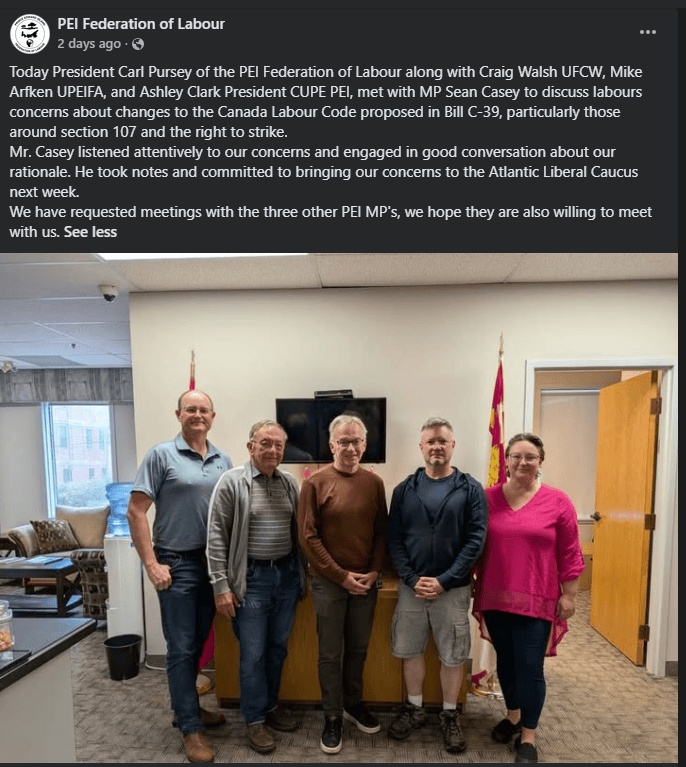
PEI Federation of Labour Facebook post
This week, the PEI Federation of Labour posted a photo on Facebook showing labour leaders meeting with MP Sean Casey to discuss the Canada Labour Code, section 107, and the right to strike. This is what a union looks like when it decides something matters. It organizes. It shows up. It takes the meeting. It posts the photo. It commits to following up. And it puts a representative in the room.
I want to be fair here: this is good work on a labour file. Bill C-39 and section 107 are real threats to the right to strike, and unions should be fighting them. I’m not criticizing the meeting. I’m pointing at what it proves.
Because UPEIFA knows exactly how to show up for a worker’s issue. It knows how to take a meeting with a politician. It knows how to make its position public. It knows how to put a representative in the room.
The same union, in the same week. In one room, a representative fighting for the right to strike. In another room, a representative praising the administration that fired me without the due process labour unions claim to fight for.
The Federation of Labour’s post is not just a photo. It is a receipt. It is proof of what these unions are capable of, and a record of who they exclude.
The Pro-Labour Exception
There is a particular kind of PEI progressive who has spent the last week praising Sean Casey. They call him brave. They share his statement. Many of these same people describe themselves as pro-labor. They see the UPEI Faculty Association as a natural ally. And this week, they watched the PEI Federation of Labour, with a UPEIFA representative in the room, sit down with an MP to fight for the right to strike. Good. That’s what unions should do.
When these progressives praise Casey for losing a title, and then wrap themselves in solidarity with a union that applauded the loss of my job, they are not being inconsistent. They are choosing.
They are choosing the institution over the worker. The union over the Muslim. The title over the livelihood. And that choice is not accidental. It is the Palestine exception in action.
A union that praises an employer for firing a Muslim faculty member is not a union. It is a gatekeeper. And a progressive movement that refuses to hold that union accountable is not a movement for justice. It is a movement for the comfort of those who get to feel radical while never risking anything, while never defending the people who actually pay the price.
This is what it means when I say the praise for my firing is not an aberration. A union that endorses an employer skipping due process has shown you exactly whose side it is on. Fair labour practice is not its principle. It is its instrument — used when it protects the right people, abandoned when it doesn’t.
What does pro-labour mean if it doesn’t include Muslim workers? What does solidarity mean if it stops at the picket line and doesn’t cross into Palestine? Why is it easier to praise a white MP’s lost title than to defend a racialized woman’s lost job?
The Through-Line
This is not just about Muslims. When anti-Muslim racism makes it safe to fire people for political speech, it sets a precedent that threatens everyone’s right to dissent. The “Palestine exception” — where normal rules of free expression don’t apply — is a template for broader suppression.
A union that forwards a complaint is doing its job. A union that demands your removal from a committee is doing something else. A party that demotes an MP for voting against arms sales is sending a message. A progressive movement that praises the MP but abandons the Muslim worker is sending a message too.
The message is this: some people get to dissent safely. Some people get to lose a title and gain a platform. And some people get fired. Some people get restructured out of their jobs. Some people get praised by their own union for being removed.
That is not a threat to Muslims alone. It is a threat to anyone who might one day become the exception. It is a threat to anyone who believes that solidarity means something more than a photo op.
What Solidarity Actually Looks Like
Not praise for the bare minimum. Not performance. Risk-sharing. Standing with the people who are actually paying the price. Holding institutions like UPEI accountable. Refusing to let the Caseys of the world be the only story we tell.
The Faculty Association will say it was just doing its job. But a union that forwards a complaint does not demand your removal from a committee. A union that processes a grievance does not praise the administration for restructuring your department. A union that claims to stand for fair labour practice does not celebrate an employer skipping progressive discipline. A union that represents all faculty does not stand in a photo with Sean Casey while abandoning the Muslim woman it helped push out the door.
They weren’t just doing their job. They were doing exactly what they wanted to do.
And the people who praised Sean Casey for losing a title — the same people who call themselves pro-labor, who stand in solidarity with unions, who shared the Federation of Labour’s photo — they need to ask themselves what their solidarity actually means. If it doesn’t include me, if it doesn’t include the Muslims across this country who lost their jobs for saying what Casey voted for, then it is not solidarity. It is selective. It is conditional. It is comfortable.
And it is a threat — not just to Muslims, but to anyone who might one day become the exception.


Leave a comment