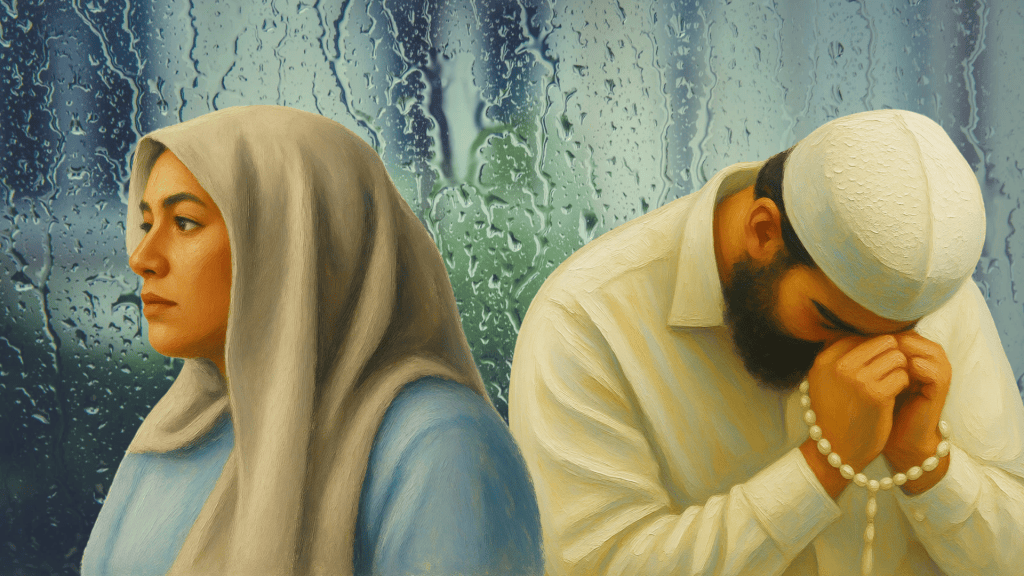
There is a particular kind of silence that follows certain deaths. When a Muslim life is lost, to war, to state violence, to a hate crime, or to the quiet attrition of neglect, the public vocabulary for grief often seems to fail. The life is not framed as a life lost so much as a threat neutralized, a statistic in a foreign conflict, or an unfortunate byproduct of security. This is not an accident of language. It is the operation of a frame that renders Muslim lives ungrievable.
The concept, developed most famously by Judith Butler, describes how dominant cultural and political frames determine which lives are recognized as living, and therefore which deaths are recognized as losses. Butler argued that the lives of Muslims and Iraqis have been treated by Western governments and media as less grievable than those of Americans, a bias that makes opposition to state violence a matter of acknowledging a shared precariousness. This is the bedrock of the problem: before one can be a victim, one must first be legible as a subject whose suffering matters.
The Default Terrorist and the Racialized Spectacle
Hatem Bazian’s work on the racialized spectacle of terror explains how this frame is produced. He argues that public discourse on terrorism is laser-focused on the Muslim subject and Islam. The term terrorist is not applied evenly. It is activated through cultural markers, a name, an appearance, that are perceived as Muslim. This creates a perceptual shortcut: the Muslim is the a priori perpetrator.
The empirical asymmetry is stark. Bazian cites a 2018 report finding that Muslim-perceived perpetrators receive 770 percent more media coverage than those not perceived as Muslim perpetrators. This is not merely a matter of over-reporting. It is a process of branding. Terrorism becomes a category uniquely crafted around the Muslim subject, built upon centuries of orientalist and colonial discourse. The result is what Bazian calls an atmospheric racism, a toxic soot that clings to the social imaginary, ensuring that even when Muslims are the victims of violence, the perceptual lens remains fixed on their supposed capacity for it.
The Hierarchy of Victimhood
This dynamic is reinforced by what scholar Arun Kundnani terms the hierarchy of victimhood. In this hierarchy, violence committed by marginalized groups is politicized and attributed to an inherent pathology, while violence against them is individualized, explained away, or rendered invisible. Hatem Bazian has described how Muslims are often doubly victimized: first by the actual violence they endure, and second by being despised as a group in the aftermath.
Khaled Beydoun’s work on Islamophobia and the global war on Muslims addresses this directly. His book The New Crusades documents the systemic nature of this targeting. Yet the critical response to Beydoun himself is instructive. When he has claimed to be the victim of an Islamophobic assault, the response from certain quarters is immediate incredulity: the Islamophobia professor is accused of fabricating victimhood for clout. The Muslim who claims to have been harmed is read through the perpetrator frame, as opportunistic, dishonest, or weaponizing identity, because the cultural script does not easily accommodate the Muslim as victim. To assert Muslim victimhood is to contest the hierarchy, and the hierarchy pushes back.
The Impossibility of the Muslim Victim
The logical endpoint of these intertwined frames is a kind of double bind. If a Muslim is killed by state violence, the death is framed as a security necessity or collateral damage, an ungrievable loss. If a Muslim survives an act of interpersonal or structural violence, their claim to victimhood is suspect, often met with demands for exceptional proof or dismissed as an exaggeration of Islamophobia. The Muslim is only ever legible as a perpetrator of harm, or as a fraudulent claimant to harm. The category of the innocent victim, the subject whose grief commands public acknowledgement, is structurally reserved for others.
This is not a claim that Muslims never experience violence. It is a claim about the conditions of recognition. The frames Butler describes do not merely distort reality. They constitute a reality in which certain lives are livable and grievable, and others are not.
Spectacle of Muslim Death
In 2005, a massive earthquake devastated northern Pakistan. Online, in Western countries, people celebrated. Some wrote that they hoped Osama bin Laden had died in it too. I have thought about those comments for years, not because they were unusual, but because they were not. A natural disaster that killed tens of thousands of people was received as though it had settled a score, and the dead were not mourned as people who had lost their lives. They were folded into a single figure: the perpetrator, the terrorist, the one who had it coming.
Anthropology professor Maura Finkelstein argues that Western society has become desensitized to violence and death in Muslim-majority regions due to entrenched Islamophobia and media framing. She asserts that decades of Western military interventions and popular culture tropes (such as cinematic orientalism) have framed Muslims collectively as a threat, allowing the public and world leaders to grow indifferent to massive civilian casualties in places like Iraq, Afghanistan, and Gaza, and that the crisis in Gaza is fueled by anti-Muslim ideology alongside the political struggle for Palestinian liberation.
By acknowledging global indifference shown toward Muslim suffering as something to be changed and challenged, Finkelstein urges readers to reject Islamophobia and stand in solidarity against all forms of hate.
The Silence in the Anti-Racism Meeting
Recently I joined an advisory group of a national anti-racism organization. I raised a proposal that the organization explicitly name anti-Zionism within its anti-racism commitments because Zionism is racism. What stayed with me was not the debate I expected. It was the sequence: silence, then a question, then a definition.
When I first brought it up in our first meeting, one person engaged — but the engagement was the worry itself: we have to be careful about accusations of antisemitism; we have to balance things. It wasn’t a discussion of whether Zionism is racism. It was a discussion of the cost of saying so. No yes. No no. Just the worry.
When I followed up after the meeting with an email including details and evidence — crickets.
Eventually, after another nudging email, one committee member responded. He acknowledged the fear that silences these conversations and agreed it should not. Then he raised an objection to one piece of evidence I had presented – Thomas Sankara’s opposition to Zionism. He asked whether Sankara’s account of replacement and dispossession was really about race, or whether it could describe any group displacing another.
I answered. Sankara was speaking of European colonization of Arab lands. Black radical thinkers were among the first, after Palestinians, to recognize Zionism as racism. And I said plainly what I had been feeling: that Palestinian and Muslim voices are often dismissed in anti-racism spaces, that Muslims are racialized, that anti-Muslim racism is racism and not merely religious bigotry, and that I had not gotten the sense in this committee that anti-Muslim racism was being taken seriously.
In this response he dropped the Sankara question entirely. Instead, he said he had not understood Muslim to be a race. He always thought it was a religion.
Let’s pause here for a moment. This is not a confession of ignorance. It is a rhetorical move, and its engine is absurdity. He knows perfectly well that no one is claiming Islam is not a religion. He knows that I did not say Muslim is a race. The sentence works precisely because it attributes to me a claim so obviously false that it discredits the position without ever engaging it. It is a reductio ad absurdum, performed rather than argued. It is a straw man delivered as a confession.
Break it down. The structure is: you said X. X is absurd. Therefore your position is absurd. But I did not say X. The “X” here is a straw man assembled from a category mistake, and the mistake is the point. By restating my argument as the claim that a religion is a race, he makes my actual argument, that Muslims are racialized and that anti-Muslim racism is racism, appear to be the kind of thing only a confused person would say. The absurdity does the dismissing for him. He never has to say the dismissal out loud.
This is why the politeness matters. The sentence is phrased as a willingness to be corrected: I always thought. That framing gives him deniability. If challenged, he can say he was simply asking a question, simply admitting what he did not know. But the content of the sentence is not a question. It is a verdict. It says, without saying, that what I am asking the committee to take seriously is self-evidently ridiculous.
And note what the absurdity protects. If the objection were substantive, if he had said that anti-Muslim racism is real but the category of race does not fit, he would have had to defend a position. He would have had to explain why racialization does not count, and that explanation would have been available for scrutiny. Instead he produced a claim so obviously false that no one could be expected to argue with it. The absurdity functions as a shield. It ends the conversation while appearing to participate in it.
This is the perpetrator frame in its most efficient form. The Muslim claim to harm is not refuted. It is recast as something no serious person would entertain, and the recasting is delivered with enough politeness that it cannot be named as dismissal. The harm goes unaddressed, and the exchange looks like a misunderstanding rather than what it was: a refusal, made to look like confusion, that used absurdity to shut the question down.
I wrote back: I did not say Muslim is a race. I said Muslims are racialized. There is a difference. I cited Sherene Razack’s work on exactly this distinction. Razack’s point is not that Muslim is a biological race, but that anti-Muslim racism operates through race thinking: through appearance, names, dress, and the presumption of violence, a diverse religious group is consolidated into a racialized suspect population, and the suspension of their rights is thereby made to seem reasonable. I noted that Islam remains a religion. Both things are true.
That was the end of the exchange.
The sequence is diagnostic. My claim about anti-Muslim racism was not met with denial exactly. It was met first with a question that sounded substantive, and then, once that question was answered, with a retreat into definition. The committee member did not engage with racialization. He substituted a category error for a response, and when the error was corrected, the conversation simply stopped. In a space explicitly committed to anti-racism, the Muslim claim to harm had to clear a bar no other claim would face: first prove the harm is real, then prove the category applies, and then, when both are established, receive silence.
This is how ungrievability operates in ordinary institutional life. It is not always a slur or a ban. Sometimes it is a question that is not quite a question. Sometimes it is a demand for more evidence, then silence when the evidence arrives. Sometimes it is the substitution of a debate about categories for a response to harm. The Muslim is not told outright that she cannot be a victim. She is simply made to keep proving it, while the conversation drifts back to the comfort of the perpetrator frame, or to the safer ground of whether the word race applies at all.
Read alongside Butler, Bazian, and Beydoun, the anecdote illustrates the hierarchy of victimhood in miniature. Anti-Muslim racism is treated as derivative, debatable, or a distraction. Muslim suffering must be translated into a category the institution already recognizes. The result is that even anti-racist spaces can reproduce the very condition they exist to dismantle.
References
Hatem Bazian
- Literature: Bazian, H. (2023). “Introduction: The Racialized Spectacle of Terror: Decolonizing Narratives of Political Violence in the West.” Islamophobia Studies Journal, 9(1).
- Core data source: The article cites the 2018 report by the Institute for Social Policy and Understanding (ISPU) Equal Treatment?, which found that “perceived Muslim” suspects receive 770% more media coverage in foiled violent plots . This data can be directly cited as the empirical basis for Bazian’s argument.
Khaled Beydoun
- Literature: Beydoun, K. A. (2023). The New Crusades: Islamophobia and the Global War on Muslims. University of California Press.
- Supplementary explanation: The book’s foreword was written by Kimberlé Crenshaw, and the content focuses on how the global War on Terror has institutionalized and disseminated Islamophobia .
Sherene Razack
- Literature 1: Razack, S. H. (2008). Casting Out: The Eviction of Muslims from Western Law and Politics. University of Toronto Press.
- Literature 2: Razack, S. H. (2022). Nothing Has to Make Sense: Upholding White Supremacy through Anti-Muslim Racism. University of Minnesota Press.
- Key concept: Razack’s “race thinking” refers to a mode of thought that divides the world into “deserving” and “undeserving” according to racial descent, thereby making the suspension of rights for racialized groups appear reasonable in the name of national security . This is the source of the phrase “race thinking” used in the article.
Judith Butler
- Literature: Butler, J. (2004). Precarious Life: The Powers of Mourning and Violence. Verso. (The theoretical origin of “grievability/ungrievability” is to be found in this book and Frames of War.)
- Supplementary note: In the search results, direct original excerpts from Butler are limited, but secondary literature confirms her argument that “frames of recognition determine which lives are recognizable as lives, and therefore which deaths are grievable” . It is recommended to cite Butler’s original works directly in the article.
Maura Finklestien
- Article: Islamophobia and spectacles of Muslim death https://www.redpepper.org.uk/global-politics/palestine-middle-east/islamophobia-and-spectacles-of-muslim-death/
Other figures mentioned in the article
- Malcolm X: The Cairo speech in 1964 (“Palestine is not a religious problem, it is a colonial problem”) can be found in reports from The New Arab and other media outlets .
- Thomas Sankara: The 1984 speech at the United Nations General Assembly (“Along with their Jewish brothers, they are anti-Zionists”) appears in the records of Opinio Juris .
- Butch Ware: The view that “Zionism is the last breath of white supremacist settler colonialism” appears in the show notes of the Sumud Podcast .
- Green Party of England and Wales: The motion passed in October 2026 defining Zionism as “an ethnonationalist political project” can be found in reports from the Tony Blair Institute and Prospect Magazine .


Leave a Reply